The Phantom Inn: Nevada's Hotel That Operated in Legal Limbo for Seven Years
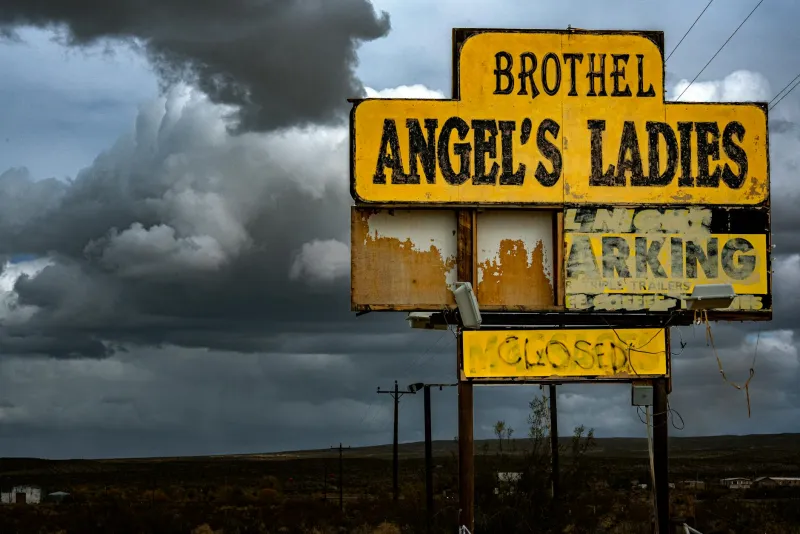
Welcome to Nowhere
For seven years in the 1950s, travelers driving through Nevada's vast desert landscape could check into the Desert Rose Hotel, enjoy a hot meal in its restaurant, and sleep comfortably in one of its 42 rooms. The establishment had everything a weary traveler needed: clean linens, running water, a functioning kitchen, and a friendly staff who knew the local area.
What it didn't have was legal existence.
The Boundary That Wasn't
The Desert Rose Hotel sat in what mapmakers call a "boundary gap"—a piece of land that falls between jurisdictional lines due to surveying errors or administrative oversight. In Nevada's case, the hotel occupied a 1.2-acre plot that somehow slipped through the cracks when Mineral County was carved out of Esmeralda County in 1911.
The original surveyor, working with 1910s technology across harsh desert terrain, had made a small but critical error. His measurements left a narrow strip of land that belonged to neither county. For decades, this oversight went unnoticed because nothing was built there. Then, in 1947, entrepreneur Frank Castellano decided it was the perfect spot for a roadside hotel.
Building in the Void
Castellano purchased the land through what he thought was a routine transaction with Mineral County. He obtained what appeared to be proper building permits, connected to existing utility lines, and constructed his hotel according to all applicable codes. The Desert Rose opened for business in 1948, and everything seemed perfectly normal.
Guests checked in using the hotel's official address: Mile Marker 247, Highway 95. The postal service delivered mail there. The telephone company installed lines. Travel guides listed it alongside other Nevada accommodations. For all practical purposes, the Desert Rose Hotel existed in the real world.
But in the world of official records, it was a ghost.
The Phantom Operations
What makes the Desert Rose story particularly eerie is how completely it functioned despite its non-existence. The hotel maintained business licenses that were technically invalid, paid taxes to counties that couldn't legally collect them, and operated under health department inspections from agencies that had no jurisdiction.
Guests who stayed there during the 1950s remember it fondly. "It was a clean, well-run place," recalled Dorothy Henderson, who stopped there multiple times while traveling between Los Angeles and Reno. "The coffee was always fresh, and Frank knew everyone's name. You'd never guess there was anything unusual about it."
The hotel even earned a AAA rating in 1953. The American Automobile Association's inspectors evaluated its facilities, checked its services, and officially recommended it to travelers. They had no idea they were endorsing a place that existed in a legal vacuum.
The Accidental Discovery
The Desert Rose's phantom status might have continued indefinitely if not for Nevada's ambitious infrastructure project in 1955. The state decided to upgrade Highway 95, widening it and improving its surface to handle increased traffic to the newly booming Las Vegas.
Surveyors arrived to map the route and determine property boundaries for potential land acquisitions. That's when they discovered the impossible: a fully operational hotel sitting on land that didn't belong to anyone.
"We kept checking our maps," remembered state surveyor Robert Martinez years later. "According to every official document, that piece of ground was empty desert. But there was this hotel, with cars in the parking lot and smoke coming from the kitchen chimney."
The Bureaucratic Nightmare
Once discovered, the Desert Rose's situation created a bureaucratic headache that took months to resolve. Neither Mineral nor Esmeralda County wanted to claim responsibility for the oversight, especially since it might involve liability issues or unpaid obligations.
Meanwhile, the hotel continued operating. Guests still needed rooms, and Castellano still had employees to pay. The surreal situation meant that health inspectors couldn't officially inspect the restaurant, but they couldn't shut it down either since they had no authority over land that didn't exist in their jurisdiction.
"It was like something out of a Kafka novel," explained Nevada Assistant Attorney General Patricia Williams, who worked on resolving the case. "We had a real business with real customers operating in a legal void. How do you regulate something that officially isn't there?"
The Resolution
The state finally solved the problem through legislative action. In 1956, the Nevada Legislature passed a special bill that retroactively incorporated the Desert Rose's plot into Mineral County, making the hotel's existence official for the first time in eight years.
Castellano was required to pay back taxes and fees, but he was also granted legal ownership of the land he had unknowingly been squatting on. All of the hotel's licenses and permits were validated retroactively, and its operations became officially legitimate.
The Modern Mystery
The Desert Rose Hotel closed in 1962, not because of its legal troubles but due to changing travel patterns as Interstate 80 diverted traffic away from Highway 95. Castellano sold the property to a rancher who demolished the buildings and returned the land to desert.
Today, only a concrete foundation and a few scattered utility connections mark the spot where Nevada's phantom hotel once stood. But the case established important legal precedents for handling boundary disputes and jurisdictional gaps.
More intriguingly, researchers have identified at least twelve other potential "boundary gaps" across Nevada where similar situations could theoretically occur. None currently contain structures, but as the state continues to develop, the Desert Rose case serves as a reminder that sometimes reality operates ahead of the paperwork that's supposed to govern it.
The Legacy of Legal Limbo
The Desert Rose Hotel's story reveals something unsettling about the invisible systems that govern our daily lives. For seven years, hundreds of travelers slept peacefully in rooms that legally didn't exist, ate meals prepared in a kitchen that no agency had authority to inspect, and paid bills to a business that couldn't officially operate.
It suggests that much of what we assume about legal order and governmental oversight might be more fragile than we realize. Sometimes, reality simply proceeds without waiting for the bureaucracy to catch up.
The next time you check into a roadside hotel, you might wonder: does this place really exist? In the case of the Desert Rose, the answer was both yes and no—a perfectly Nevada paradox in a state built on impossible dreams.