The Boy Who Fell Over Niagara and Lived: A Seven-Year-Old's Impossible Survival
The Accident That Defied Every Odd
Niagara Falls has claimed the lives of thousands over the centuries, including numerous daredevils who spent months planning elaborate contraptions designed to protect them during their intentional plunges. So when seven-year-old Roger Woodward accidentally went over the falls in 1960 wearing nothing but a life jacket and somehow lived to tell about it, it defied not just the laws of probability, but everything we thought we knew about the falls' deadly power.
This isn't a story about preparation, bravery, or elaborate planning. It's about the most impossible survival in Niagara Falls history — and it happened completely by accident.
A Family Outing Turns Catastrophic
July 9, 1960, started as a perfect summer day for a family adventure. Roger Woodward, his 17-year-old sister Deanne, and family friend James Honeycutt decided to take a boat ride on the Niagara River above the falls. Honeycutt, an experienced boater, was piloting a 14-foot aluminum boat with a 7.5-horsepower outboard motor — nothing fancy, but adequate for a leisurely cruise.
What they didn't fully appreciate was how deceptively calm the Niagara River appears before it reaches the point of no return. The current above the falls is swift but smooth, giving little indication of the violence that awaits downstream. By the time they realized they were in trouble, the boat was already being pulled toward the falls with unstoppable force.
When Everything Goes Wrong
The boat's motor couldn't overcome the increasingly powerful current. As they approached the falls, Honeycutt made a desperate decision — he aimed the boat toward shore and told the children to jump. Deanne managed to leap to safety near Goat Island, where bystanders pulled her from the water just 20 feet from the brink of the American Falls.
Honeycutt wasn't as fortunate. He went over the falls with the boat and was killed instantly, his body recovered four days later.
Roger, the smallest of the three, was swept away from the boat and carried by the current toward the much larger and more powerful Horseshoe Falls — the main attraction that has killed virtually everyone who has gone over it, whether by accident or design.
The Physics of the Impossible
What happened next shouldn't have been survivable. The Horseshoe Falls drops 167 feet into a churning cauldron of water and rocks. The force of 750,000 gallons of water per second creates a hydraulic system that typically traps and pulverizes anything that goes over.
Professional daredevils who have attempted the falls in barrels, balls, and other protective devices have often died from the impact alone, even when their containers remained intact. The few who survived spent months designing their apparatus and carefully calculating factors like weight distribution, impact absorption, and flotation.
Roger had none of this. He was a 40-pound child in a simple orange life jacket, tumbling through one of the world's most powerful waterfalls.
The Miracle in the Mist
Somehow, Roger survived the fall itself. But survival at the bottom of Niagara Falls presents its own deadly challenges. The area below the falls is a maelstrom of churning water, dangerous currents, and massive boulders. Most people who survive the initial impact are quickly pulled under by the hydraulic action of the falls or dashed against the rocks.
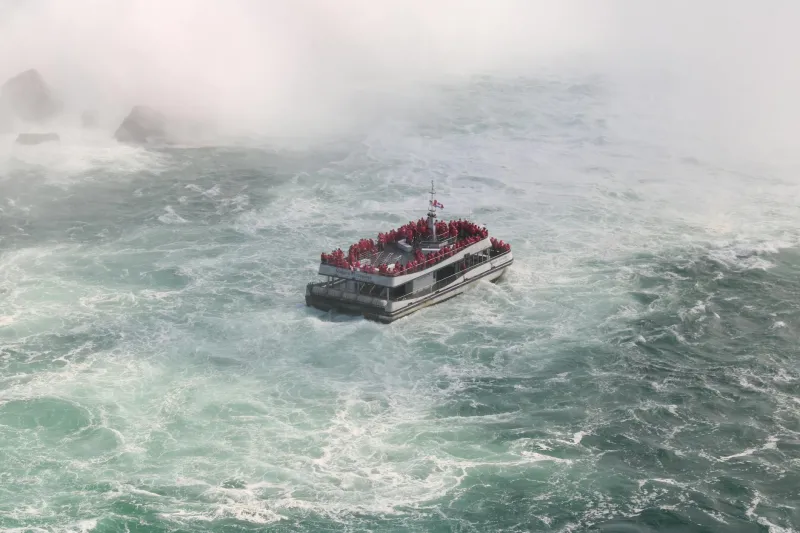
Roger bobbed to the surface, conscious and alert, in relatively calm water downstream from the falls' base. The tour boat Maid of the Mist II happened to be in the area and spotted the small figure in the orange life jacket. Captain Clifford Keech maneuvered his vessel through dangerous waters to reach the boy, pulling him aboard approximately 40 minutes after he had gone over the falls.
Roger's injuries were shockingly minor: a few cuts and bruises, and nothing more. He was conscious, coherent, and asking for his sister.
The Daredevil's Perspective
To understand how remarkable Roger's survival was, consider the fate of those who deliberately challenged the falls. Annie Edson Taylor, the first person to survive going over Niagara Falls in a barrel in 1901, emerged badly injured despite her careful preparations. Many others died in the attempt, their protective devices proving inadequate against the falls' power.
George Stathakis went over in a barrel in 1930 and died not from impact but from suffocation when his barrel became trapped behind the falls for 14 hours. Charles Stephens attempted the feat in 1920 in a wooden barrel; only his right arm was ever recovered.
These were adults who spent considerable time and money designing what they hoped would be life-saving apparatus. Roger was a child with a basic life jacket who wasn't even trying to survive the falls — he was just trying not to drown.
The Science of Survival
Experts have theorized about why Roger survived when so many others perished. His small size and light weight likely helped — he may have been carried by the water rather than fighting against it. The life jacket kept him properly positioned and provided some protection. The specific conditions that day, including water levels and current patterns, may have created an unusually survivable path through the falls.
But ultimately, his survival remains largely inexplicable. Every factor that should have killed him — the height of the fall, the force of the water, the dangerous currents below — somehow worked in his favor instead.
A Quiet Hero's Legacy
Roger Woodward grew up to become a successful businessman, rarely speaking publicly about his experience. Unlike the daredevils who sought fame through their Niagara attempts, he never capitalized on his survival story. He simply went on to live a normal life, perhaps understanding better than most how precious and fragile that normalcy really is.
His sister Deanne, who witnessed the entire tragedy, has said that while she's grateful for Roger's survival, the loss of James Honeycutt haunts the family to this day. The miracle of one survival doesn't erase the tragedy of one death.
The Impossible Made Real
Roger Woodward's survival remains the most improbable rescue in Niagara Falls history. It's a story that challenges our understanding of physics, probability, and the thin line between life and death. In a place where preparation, planning, and protective equipment have so often failed, a seven-year-old boy with nothing but a life jacket accomplished what seemed impossible.
Sometimes the most extraordinary stories are the ones that happen to ordinary people on ordinary days, when the universe briefly suspends its usual rules and allows the impossible to become real.