Seven Times Struck: The Ranger Who Became Lightning's Favorite Target
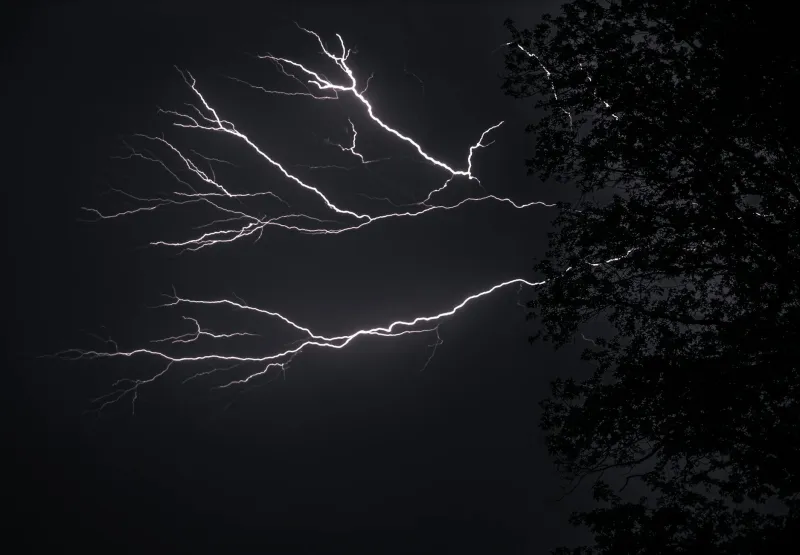
When Lightning Picks a Favorite
If you've ever worried about being struck by lightning, the odds should comfort you. The National Weather Service estimates that the odds of a single person being struck by lightning in a given year is about 1 in 500,000. Over a lifetime, it's roughly 1 in 15,300. Now imagine being struck not once, not twice, but seven times. The probability becomes so astronomically small that mathematicians struggle to calculate it.
For Roy Sullivan, a ranger at Shenandoah National Park in Virginia, this nightmare wasn't theoretical—it was his life.
The Strikes That Shaped a Curse
The first strike came on July 7, 1942, when Sullivan was working in the park. Lightning ripped through his body, burning his left shoulder and leg. He survived, though the pain was excruciating. Most people struck by lightning once spend the rest of their lives grateful and cautious. Sullivan would learn that caution meant nothing against whatever cosmic force had targeted him.
Four years passed before the second strike, in July 1946. This time, it burned his eyebrows off and permanently damaged his hearing in one ear. The third strike followed in 1949, searing his leg again. By the fourth strike in 1954, Sullivan had begun to notice a pattern that would haunt him: lightning seemed drawn to him specifically, almost deliberately, as if the sky itself had a vendetta.
The fifth strike in 1962 was particularly vicious. Sullivan was struck while standing inside his house—inside, mind you—as lightning traveled through the telephone wires and found him at the other end. His hair caught fire. He suffered severe burns across his body. Hospital staff marveled that he was still alive, let alone conscious.
Two more strikes followed: one in 1969 that burned his chest and legs, and the final, most brutal strike in 1977 that set his hair ablaze again and left him with third-degree burns across his entire body.
The Mathematics of Impossibility
When scientists and statisticians examined Sullivan's case, they struggled to find words adequate to the improbability. One calculation suggested the odds of his experience were approximately 1 in 500 million. Another expert put it differently: it was roughly equivalent to being dealt a royal flush in poker multiple times in a row. Lightning simply does not strike the same person repeatedly. It violates everything meteorologists understand about how electricity distributes itself across a landscape.
Yet there was Roy Sullivan, walking proof that the impossible could, in fact, happen.
The medical community was equally baffled. Sullivan survived injuries that would have killed most people. He endured burns, neurological damage, and repeated trauma to his nervous system. Doctors who treated him noted that his survival seemed almost defiant of natural law. Some colleagues whispered about his resilience being supernatural. Others simply admitted they had no explanation.
The Psychological Weight of Being Hunted
What the statistics don't capture is the psychological toll of being lightning's favorite target. Sullivan became hyperaware of weather patterns. Thunderstorms, which most people find merely inconvenient or mildly frightening, became a source of primal dread for him. Every rumble of thunder, every flash of lightning on the horizon, triggered a fear response that was entirely rational given his history.
He developed strategies to protect himself. He avoided going outside during storms, obviously. But he also became acutely conscious of his surroundings even on clear days, wondering if today might be the day lightning decided to strike again. The psychological burden of surviving seven lightning strikes wasn't just the physical scars—it was the constant, exhausting vigilance.
Sullivan tried to maintain his sense of humor about his curse. He would joke with colleagues about being a "lightning rod." But those who knew him well could see the toll it took. Living under the shadow of such improbable catastrophe, always aware that statistics suggested something impossible had already happened to you multiple times, creates a particular kind of trauma.
The End of an Impossible Story
Roy Sullivan's story reached its tragic conclusion in 1978, just a year after his final lightning strike. He died by suicide, shooting himself in a secluded spot in Shenandoah National Park. He was 51 years old.
The official records note his death as unrelated to his lightning strikes—a separate tragedy. But those who knew him understood that a man struck by lightning seven times, who had survived injuries that should have been fatal, who had lived in constant fear of the next strike that surely must come, had finally reached the limit of what a human mind and body could endure.
Roy Sullivan holds the Guinness World Record for being struck by lightning more times than any other person. His story is documented in medical journals, meteorological studies, and books about survival against impossible odds. Yet it remains one of the most haunting reminders that sometimes, reality is so strange and cruel that no writer of fiction would dare use it. The universe doesn't always play by the rules we expect. Sometimes it singles someone out—again and again and again—and tests them beyond what seems humanly possible.
Sullivan's curse was real. And it lasted until the very end.