The Ghost Signal That Haunted America: Inside the USSR's Secret Radio Weapon
The Ghost Signal That Haunted America: Inside the USSR's Secret Radio Weapon
Picture this: you're listening to your favorite radio station in 1976 when suddenly, an aggressive tapping sound cuts through the music. Tap-tap-tap-tap. It sounds like someone drumming their fingers on a microphone, but amplified and relentless. You change stations, but it's there too. You try the phone — the tapping follows you. Even your television starts clicking.
For millions of Americans, this wasn't imagination. It was daily life during one of the Cold War's most bizarre chapters.
When America's Airwaves Went Haywire
Starting in July 1976, a powerful radio signal began appearing across North America with the regularity of a heartbeat. Amateur radio operators called it "the Woodpecker" because of its distinctive pecking rhythm — 10 pulses per second, 24 hours a day, 365 days a year.
But this wasn't just annoying background noise. The signal was so powerful it could overwhelm local radio stations, interrupt phone calls, and even cause clicks in home stereo systems. Truck drivers reported their CB radios becoming unusable. Emergency services found their communications jammed.
The Federal Communications Commission was flooded with complaints, but they had no answers. Officially, the signal didn't exist.
The Mystery Deepens
What made the Woodpecker truly eerie was its behavior. The signal would hop frequencies seemingly at random, as if it were alive and hunting for the best transmission path. Sometimes it would disappear for hours, only to return stronger than before on a completely different frequency.
Radio enthusiasts became obsessed with tracking it. They created detailed logs, noting when it appeared and where. Some claimed they could predict its movements. Others swore it was targeting specific types of broadcasts — always seeming to interfere with music more than talk radio.
Conspiracy theories flourished. Was it mind control? Weather manipulation? A Soviet plot to drive Americans insane through constant audio harassment?
The truth, when it finally emerged, was somehow both more mundane and more incredible than any theory.
The Forest That Hid a Giant
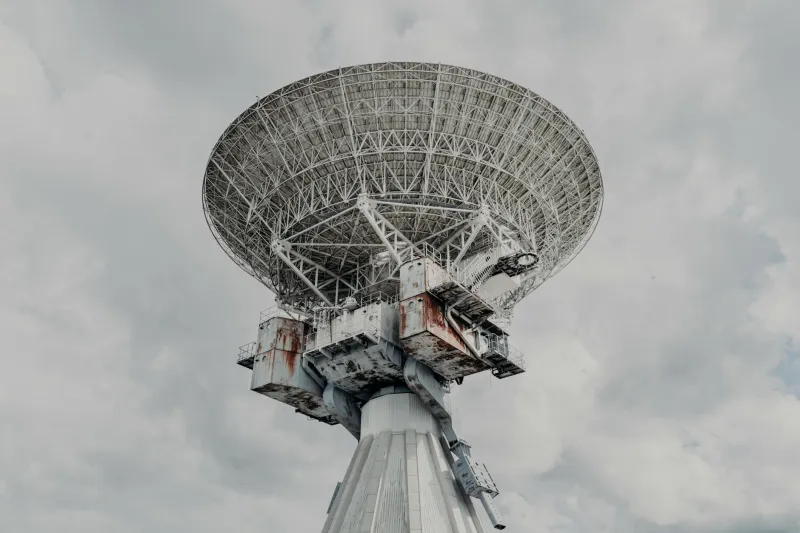
In the dense forests near Chernobyl, Ukraine (yes, that Chernobyl), stood one of the most ambitious engineering projects of the Soviet Union. Hidden from satellite surveillance by trees, the Duga radar system stretched nearly half a mile across the landscape.
This wasn't just any radar. The Duga was an "over-the-horizon" system designed to detect incoming ballistic missiles by bouncing radio waves off the ionosphere — essentially using the Earth's atmosphere as a giant mirror to see beyond the horizon.
To accomplish this seemingly impossible task, the Duga needed to transmit with extraordinary power: 10 million watts, roughly 500 times stronger than a typical radio station. When those signals bounced back to Earth, they landed squarely in the radio frequencies used by civilian broadcasters worldwide.
The Accidental Invasion
The Soviet engineers knew their system would interfere with international radio traffic. They just didn't care. In their calculations, the ability to detect American missiles 15 minutes earlier was worth any amount of global radio disruption.
What they didn't anticipate was how the interference would be perceived. To American listeners, the Woodpecker felt like an invasion — not of missiles, but of sound. Soviet radio waves were literally entering American homes, making their presence known with every tap.
The psychological effect was profound. During the height of the Cold War, millions of Americans were reminded daily that the USSR possessed technology powerful enough to reach into their living rooms.
The Signal That Outlived Its Purpose
The Woodpecker continued its relentless tapping until December 1989, just weeks after the Berlin Wall fell. By then, satellite technology had made over-the-horizon radar obsolete. The Soviet Union was crumbling, and maintaining the massive Duga system was no longer worth the cost.
But the story doesn't end there. The Duga still stands in the Chernobyl Exclusion Zone, now a massive steel skeleton slowly being reclaimed by the forest. Urban explorers who venture into the abandoned facility report an eerie sensation — as if the antenna is still listening, still searching the horizon for threats that will never come.
The Legacy of the Ghost Signal
The Woodpecker incident revealed how invisible warfare could be waged through radio waves. For thirteen years, the Soviet Union maintained a constant presence in American airspace without firing a shot or sending a single plane.
Today, similar concerns persist about electronic warfare and signal intelligence. The difference is that modern systems are designed to be undetectable. The Woodpecker was the last great ghost signal — powerful enough to announce its presence to the world, impossible to ignore, and completely beyond anyone's ability to stop.
Sometimes the most unsettling discoveries are the ones hiding in plain sight, tapping on your radio, reminding you that someone on the other side of the world is always listening.