Lightning Strikes Twice: The Businessman Who Survived Both Atomic Bombs
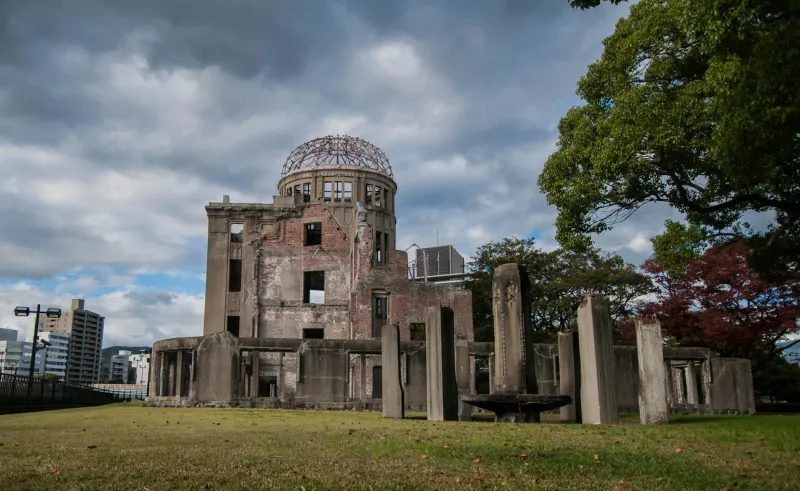
Lightning Strikes Twice: The Businessman Who Survived Both Atomic Bombs
The odds of being struck by lightning in your lifetime are roughly 1 in 15,300. The odds of surviving a nuclear bomb are incalculable — most people within the blast radius simply don't. Now imagine the mathematical impossibility of being present for both atomic bombings in World War II and walking away from each one.
For Tsutomu Yamaguchi, this wasn't a thought experiment. It was Tuesday and Friday of the same week in August 1945.
The Business Trip from Hell
On August 6, 1945, Yamaguchi was wrapping up a three-month assignment in Hiroshima for Mitsubishi Heavy Industries. The 29-year-old naval engineer was scheduled to return home to Nagasaki that morning, but a forgotten hanko (personal seal) forced him to make one last trip to the office.
At 8:15 AM, as Yamaguchi walked across a potato field toward the Mitsubishi shipyard, he noticed a B-29 bomber overhead. Nothing unusual — Allied planes had been flying reconnaissance missions over Japanese cities for months. Then he saw something fall from the aircraft.
"I saw a flash," Yamaguchi later recalled. "It was like a magnesium flare going off. I was blown over and temporarily blinded."
The flash was Little Boy, the first atomic weapon used in warfare, detonating 1.6 miles above the city.
Surviving the Unsurvivable
When Yamaguchi regained consciousness, the world had changed. The bustling industrial city of Hiroshima had been replaced by a moonscape of rubble and fire. His left side was severely burned, his eardrums were ruptured, and he was temporarily blind in his left eye.
But he was alive.
Out of approximately 350,000 people in Hiroshima that morning, between 70,000 and 80,000 died instantly. Thousands more would die from radiation sickness in the following weeks. Yamaguchi, despite being less than two miles from ground zero, somehow survived the initial blast, the thermal radiation, and the shock wave that followed.
He spent the night in an air-raid shelter, then made his way to the train station. Incredibly, some rail service had been restored. On August 8, bandaged and barely able to walk, Yamaguchi boarded a train home to Nagasaki.
The Impossible Coincidence
Yamaguchi arrived in Nagasaki on August 8, grateful to be alive and eager to reunite with his wife, Hisako, and infant son, Katsutoshi. He reported to his supervisor at the Mitsubishi office, describing the devastating new weapon he'd witnessed in Hiroshima.
His boss was skeptical. "One bomb cannot destroy a whole city," the man argued.
They were still debating the point at 11:02 AM on August 9 when Fat Man, the second atomic bomb, exploded 1.8 miles from the Mitsubishi office where Yamaguchi sat.
"The same white flash filled the room," Yamaguchi remembered. "I thought the bomb had followed me from Hiroshima."
Once again, he survived.
The Mathematics of Impossibility
The statistical probability of Yamaguchi's experience defies calculation. Consider the variables: being in two specific cities on two specific days, surviving both blasts, and living to tell about it. Some historians estimate the odds at roughly 1 in several billion.
But Yamaguchi's survival wasn't just about being in the right place at the right time (or wrong place, depending on perspective). His position during both bombings likely saved his life. In Hiroshima, he was partially shielded by the landscape. In Nagasaki, the hills surrounding the city absorbed much of the blast's energy.
The Man Who Became a Symbol
After the war, Yamaguchi returned to work for Mitsubishi, eventually becoming a translator and later a teacher. For decades, he rarely spoke about his experiences. In Japan, atomic bomb survivors (hibakusha) often faced discrimination due to fears about radiation exposure and genetic damage.
It wasn't until the 1990s, as historical interest in atomic bomb survivors grew, that Yamaguchi began sharing his story publicly. He became an advocate for nuclear disarmament, using his unique perspective to argue against nuclear weapons.
"I could have died on either of those days," he said in a 2005 interview. "Everything that followed was a bonus."
The Unheard American Story
Despite being the only person officially recognized by Japan as surviving both atomic bombings, Yamaguchi remained largely unknown in the United States for decades. His story didn't fit neatly into American narratives about the bombs that ended World War II.
American textbooks focused on the strategic necessity of the bombings and their role in Japan's surrender. Individual survival stories, particularly ones that highlighted the weapons' devastating effects on civilians, were often overlooked.
It wasn't until 2009, just a year before his death at age 93, that Yamaguchi's story gained widespread attention in the U.S., partly through a documentary called "Twice Survived: The Doubly Atomic Bombed of Hiroshima and Nagasaki."
The Message in the Miracle
Yamaguchi lived for 65 years after his double encounter with atomic weapons, dying of stomach cancer in 2010 (though doctors couldn't definitively link his cancer to radiation exposure). His longevity itself seemed to defy the conventional wisdom about radiation's effects.
In his final years, he often reflected on the meaning of his survival: "Having experienced atomic bombings twice and survived, it is my destiny to talk about it."
His story serves as a reminder that behind every historical statistic is a human being, and sometimes those human beings experience things that seem to break the very laws of probability. In Yamaguchi's case, surviving the impossible twice gave him a platform to speak for those who couldn't.
The man who should have died twice instead became a living testament to both human resilience and the devastating power of nuclear weapons — a walking, talking reminder that truth is often stranger than fiction.