The Great Alaskan Exodus: When an Entire City Decided to Pack Up and Leave
When Nature Forces Your Hand
Imagine waking up one morning to discover that your entire hometown—every street, every building, every familiar landmark—needs to be abandoned forever. That's exactly what happened to the 554 residents of Valdez, Alaska, in the aftermath of the Great Alaskan Earthquake of 1964.
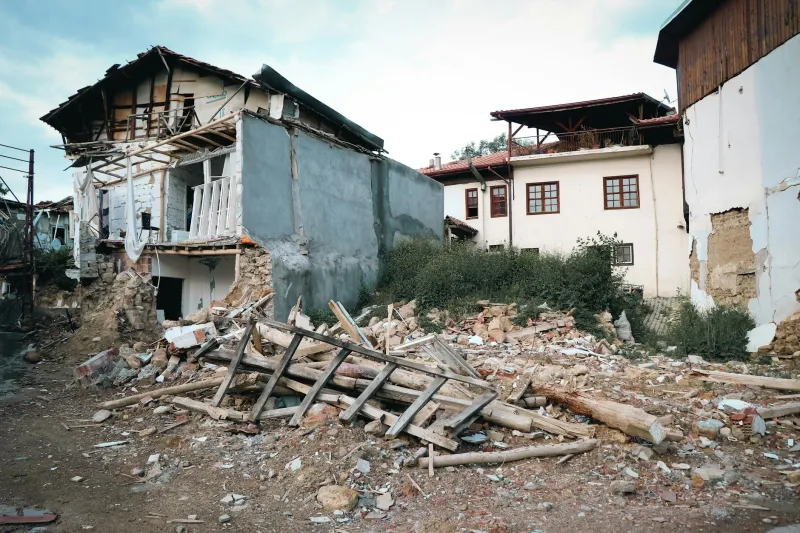
On Good Friday, March 27, 1964, the most powerful earthquake ever recorded in North American history struck Alaska with a magnitude of 9.2. The quake lasted four and a half terrifying minutes, but for Valdez, the real nightmare was just beginning. The unstable clay beneath the town liquefied, causing massive landslides that swallowed entire neighborhoods and sent the town's dock—along with 30 people—sliding into Prince William Sound.
The Impossible Decision
As rescue workers pulled survivors from the wreckage, geologists delivered devastating news: Valdez sat on fundamentally unstable ground that could never safely support a community again. The town faced an unprecedented choice—abandon their home forever or attempt something that had never been done on this scale in American history.
The residents chose the impossible: they would move their entire city.
Not just the people, mind you, but everything—the post office, the school, the cemetery, even the city charter itself. In a series of town hall meetings that must have felt surreal, citizens voted to relocate Valdez three miles east to more stable ground. It was democracy in action, except the question on the ballot was essentially: "Should we pick up our entire town and move it?"
Living in Two Places at Once
What followed was perhaps the strangest chapter in American municipal history. For several years, Valdez existed in two places simultaneously—Old Valdez, a ghost town slowly being reclaimed by nature, and New Valdez, rising from scratch on safer ground.
Families found themselves commuting between versions of their hometown. Mail was delivered to both locations. The city government operated out of temporary buildings while overseeing the construction of an entirely new municipal infrastructure. Children attended school in prefabricated classrooms while their parents worked to recreate a community that had existed for decades.
The logistics were mind-boggling. How do you move a cemetery? The answer: very carefully, and with a lot of paperwork. Every grave had to be exhumed, every casket relocated, and every headstone transported to the new burial ground. The process took years and required delicate negotiations with families scattered across the country.
The Bureaucratic Nightmare
Perhaps most bizarre was the legal limbo that emerged. For a time, Valdez officially existed in two locations according to various government agencies. Some federal records listed the old coordinates, others the new ones. Mail delivery became an exercise in educated guessing. Insurance companies struggled to determine which version of the town their policies covered.
The Alaska Department of Transportation found itself maintaining roads to both locations—one serving a growing community, the other leading to an increasingly empty ghost town. The U.S. Postal Service had to establish new ZIP codes while somehow ensuring that mail addressed to the old location found its way to residents who had moved three miles east.
Building Tomorrow from Yesterday's Ashes
By 1967, New Valdez was officially incorporated, and the transition was largely complete. The new town featured wider streets designed to modern earthquake standards, improved utilities, and buildings constructed to withstand future seismic activity. It was like watching an entire community get a do-over, complete with the benefit of hindsight and federal disaster funding.
But the human cost was immeasurable. Families lost not just their homes but their sense of place. The corner store where they'd bought candy as children was gone forever. The park where they'd had their first kiss existed only in memory. Even the view from their front porch—something most people take for granted as permanent—had fundamentally changed.
The Town That Lived Twice
Today, visitors to Valdez can still see remnants of the old town site, now marked by a few weathered foundations and a memorial to those who died in the earthquake. The new city thrives as a major port and tourist destination, its wide streets and modern buildings a testament to human resilience and the willingness to start over.
The story of Valdez represents something uniquely American—the belief that when disaster strikes, you don't just endure; you rebuild, even if that means picking up an entire community and moving it down the road. It's a reminder that sometimes the most practical solution is also the most audacious one.
In a nation built on the idea of pulling up stakes and starting fresh, Valdez took that concept to its logical extreme. They didn't just move to a new town—they moved their town itself, proving that home isn't just where the heart is; sometimes, it's wherever you decide to put it.