Built to Sink: The 19th-Century Ship That Managed to Go Down Twice, in Two Different Oceans
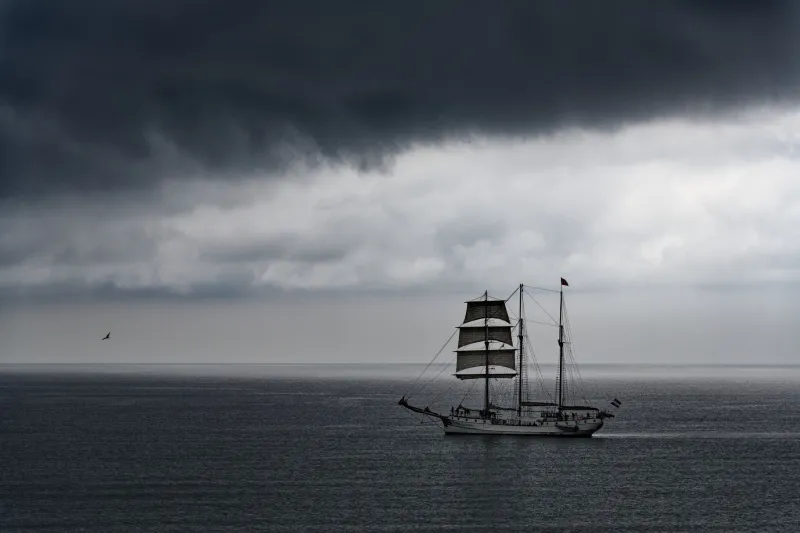
Maritime history is full of ships that sank once. That's already enough of a story — the weather, the cargo, the desperate hours, the survivors who made it to shore with nothing but their accounts. What maritime history offers only rarely is a ship that sank, came back, and then sank again, in a different ocean, in a way that made experienced sailors go very quiet when they heard about it.
The merchant vessel originally registered as the Eliza Jane Morrow was built in 1847 in a shipyard outside of Baltimore. She was a three-masted bark of medium tonnage, designed for transatlantic cargo routes — the kind of workhorse vessel that carried cotton, timber, and manufactured goods across the Atlantic without anyone expecting her to be remarkable. For the first decade of her life, she wasn't.
The First Disaster
In the winter of 1858, the Eliza Jane Morrow encountered a storm system off the coast of the Azores that her captain, a veteran named Samuel Oakes, later described in his incident report as "the most violent atmospheric event I have encountered in thirty-one years of ocean passage." The ship lost two masts, took on catastrophic amounts of water, and went down in approximately 600 feet of water over the course of about four hours.
All but two of the crew survived, rescued by a Portuguese fishing vessel that happened to be riding out the same storm at anchor near a small island. Captain Oakes survived. His incident report, filed with maritime authorities in New York, noted that the Eliza Jane Morrow had exhibited unusual structural stress in her lower hull throughout the voyage and that he had submitted a maintenance request three weeks prior that had not been addressed.
The ship was insured. The owners collected. That should have been the end of it.
But the wreck had gone down in relatively shallow water for that stretch of the Atlantic, and within two years, a salvage operation funded by a consortium of Boston merchants had pulled the hull — battered but largely intact — back to the surface. The cost of the salvage was significant. The decision to rebuild rather than scrap was driven purely by economics: the recovered hull was structurally sound enough, the salvagers argued, to justify restoration.
She was towed to a shipyard in Lisbon, where Portuguese craftsmen spent the better part of a year repairing her. New masts were stepped. The lower hull was reinforced — though later analysis would suggest not as thoroughly as the original incident report had recommended. She was renamed the Santa Catarina do Mar and sold to a Portuguese trading company with interests in Pacific commerce.
A Long Journey to a Familiar End
For nearly a decade, the Santa Catarina do Mar operated without incident on routes between Lisbon, Cape Town, and various Pacific ports. She carried spices, textiles, and manufactured goods. She changed hands twice. By 1871, she was operating under a third name — the Meridian Star — and was owned by a San Francisco trading firm that used her for runs between California and the Hawaiian Islands.
In November of 1871, the Meridian Star encountered a storm system in the central Pacific that her captain — a man named Thomas Carver who had been sailing for twenty-eight years — described in his log as the worst weather he had ever experienced at sea. The ship lost two masts. She took on catastrophic amounts of water. She sank.
All but three of the crew survived, rescued by a passing vessel. Captain Carver survived. His incident report, filed in San Francisco, noted unusual structural stress in the lower hull and referenced a maintenance request submitted weeks earlier that had not been fully addressed.
The parallels were so precise that when maritime historians first began comparing the two incident reports in the 20th century, at least one initially assumed the documents had been misfiled and were actually duplicates of the same event.
The Sailors Who Already Knew
What gives this story its particular texture is that some of the men who sailed the Meridian Star in her final years apparently knew exactly what they were sailing on. Maritime communities in the 19th century were small and interconnected, and ship histories traveled with sailors the way rumors travel in a small town.
At least two crew members of the Meridian Star's final voyage had, according to later accounts, served on vessels that had worked alongside the Santa Catarina do Mar during her Pacific years. One of them — a boatswain named Patrick Hennessey, who survived the 1871 sinking — reportedly told a San Francisco newspaper shortly after the disaster that he had known the ship's history and had considered leaving the crew before departure.
When asked why he stayed, he said he hadn't wanted to seem superstitious.
What the Records Actually Reveal
The eerie symmetry of this story — two storms, two lost masts, two catastrophic hull failures, two incident reports citing the same unaddressed maintenance issue — points less toward supernatural bad luck and more toward something arguably stranger: the same structural flaw, identified and never fully fixed, expressing itself twice, a decade apart, in two different oceans.
The lower hull reinforcement done in Lisbon after the first sinking was, by most accounts, adequate but not thorough. The ship was returned to service with a hull that had already failed once and had not been restored to its original specifications. Every captain who sailed her afterward inherited that compromise without necessarily knowing its full history.
The Meridian Star rests somewhere in the central Pacific. The Eliza Jane Morrow rests somewhere in the Atlantic. They are the same ship. They sank the same way. And somewhere between those two facts is the kind of coincidence that doesn't feel like a coincidence at all — which might be the most unsettling thing about it.