Dord, Aprons, and Peas: The Accidental Words Living Rent-Free in Your Head
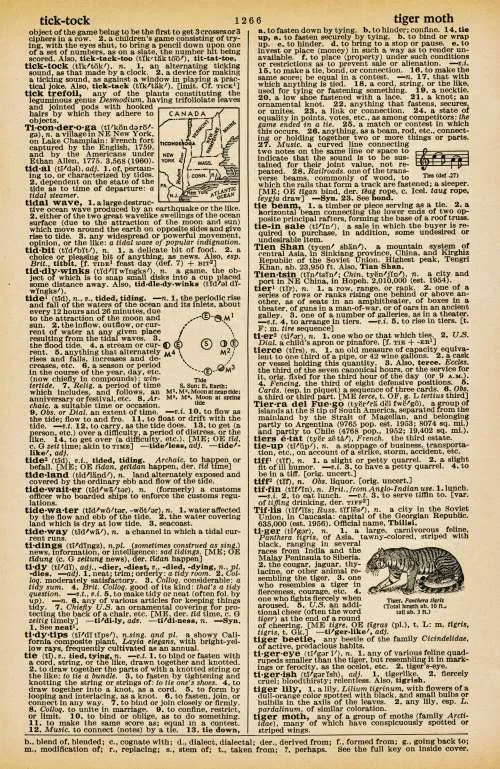
Photo: vintage dictionary close-up old book pages typography, via knickoftime.net
Somewhere in your vocabulary are words that should not exist. Not slang, not abbreviations — genuine, dictionary-verified English words that were born from typos, misread handwriting, and printers who cut corners. You use them. Everyone uses them. And every single one is a mistake that refused to apologize.
Dord: The Word That Meant Nothing
Start with the legend. In 1934, Webster's New International Dictionary — the gold standard of American lexicography — published an entry for "dord," listed as a noun meaning "density" in physics and chemistry.
There was no such word.
The story, as lexicographers pieced it together, is beautifully mundane. A contributor had sent in a note reading "D or d" — meaning the word "density" could be abbreviated either way. Someone at the publisher's office saw the squiggle, squinted, and read it as a single word: Dord. It got a pronunciation, a part of speech, a definition, and a page of its own.
The ghost word survived until 1939, when an editor finally noticed that dord had no etymology, no citations, no history — nothing but confidence. It was quietly removed, and lexicographers coined a term for such phantoms: "ghost words." Dord never meant anything, yet for five years it was as real as any word in the language, purely because a dictionary said so.
The Apron That Used to Be a Napron
Now for the word you said out loud today. An "apron" was never originally an apron. It was a "napron" — from the Old French naperon, a little tablecloth, which is also where we get "napkin."
The problem was how English speakers hear language. "A napron" and "an apron" sound nearly identical, and for centuries people parsing speech by ear simply re-divided the boundary wrong. The "n" migrated from the noun to the article, and by the 1600s the misdivision won. The same process gave us a "pea" — the original English word was "pease," singular and plural, as in the nursery rhyme "pease porridge hot." Speakers assumed "pease" was plural, backed it off by one letter, and invented a singular vegetable that never linguistically existed.
Linguists call this "rebracketing," and once you see it, you can't unsee it. It's why we say "a newt" instead of "an ewte," and why the humble apron is wearing its own name slightly wrong.
Nickname: A Name That Got Mangled Twice
"Nickname" is another crime scene. The Middle English term was "ekename" — literally an "eke name," an additional or added name. Say "an ekename" fast, mishear it the way medieval English speakers did, and you get "a nekename." The mistake was so widespread it fossilized into standard spelling. Every time you call Robert "Bob" or your buddy "Champ," you're using a word that exists because an entire language collectively mispronounced a phrase for a couple of hundred years and then committed.
The Translation Error Hiding in a Syllabus
Lesser known but just as strange: "syllabus." When the Dutch scholar Bonaventura Vulcanius coined the term in the 16th century, he garbled the Greek word sittyba (a label or title). He intended to revive a Latin word, but he misremembered it — the real Latin term was syllaba. The error got printed, and rather than correct it, the academic world adopted the mistake wholesale. Every college student in America downloads a syllabus every semester from a word that is, technically, a 450-year-old typo.
Why Mistakes Stick
Here's the eerie part. Language is supposed to be a system of rules, policed by teachers, editors, and dictionaries. Yet these examples show the opposite dynamic: usage is a stampede, and correctness is whatever survives it. Dord only died because a human caught it in time. Apron, pea, nickname, and syllabus lived because nobody did — or because so many people made the same error that the error became the truth.
Every dictionary is, in the end, a museum of accidents that got comfortable. The next time a word feels perfectly natural coming out of your mouth, remember: it might be there because a printer squinted, a scholar misremembered, or a whole country heard one word and wrote down another.
English isn't a language. It's a pile of typos that won.