The Rock That Two Nations Forgot: America's Last Territorial Mystery
The Island That Diplomats Forgot
Somewhere off the coast of Maine sits a 20-acre chunk of granite that represents one of the most embarrassing oversights in the history of international diplomacy. Machias Seal Island has been claimed by both the United States and Canada for 240 years, not because the two countries can't agree on who owns it, but because every single treaty negotiator since 1783 has somehow managed to forget it exists.
This isn't a story about competing claims or ancient grievances. It's the tale of how the same small rock has fallen through the cracks of every major border agreement between two of the world's most organized nations, creating North America's politest—and strangest—territorial dispute.
The Treaty That Started It All Wrong
The trouble began with the Treaty of Paris in 1783, which ended the Revolutionary War and established the boundary between the new United States and British North America. The negotiators had one job: draw clear lines on a map so future generations wouldn't have to fight over who owned what.
They succeeded almost everywhere. The treaty meticulously described the border from Maine to Minnesota, accounting for rivers, lakes, and even individual islands. But when it came to the waters off Maine's coast, something went wrong. The treaty mentions several islands by name, describes others by their relationship to the mainland, and then... stops. Machias Seal Island, sitting 12 miles off the coast, simply doesn't appear anywhere in the document.
This might have been a simple oversight, except that both sides immediately began acting as if they owned it. American fishermen used it as a base. British colonial authorities included it in their maritime surveys. And nobody bothered to clarify the situation because, frankly, it was just a rock covered in bird droppings.
The Pattern That Never Broke
What happened next is where the story becomes truly bizarre. Over the following two centuries, American and British (later Canadian) negotiators had multiple opportunities to resolve the Machias Seal Island question. They signed major boundary treaties in 1794, 1814, 1842, and 1910. Each time, both sides knew the island was disputed. Each time, they meant to include it in their negotiations. And each time, somehow, they didn't.
The Webster-Ashburton Treaty of 1842 came closest to settling the matter. Daniel Webster and Lord Ashburton spent months haggling over every detail of the Maine-New Brunswick border, including several other disputed islands. They had maps, surveys, and detailed correspondence about Machias Seal Island specifically. The final treaty resolves the status of nearby islands with surgical precision—and then inexplicably fails to mention Machias Seal Island at all.
It's as if the island had some kind of diplomatic invisibility cloak.
The Lighthouse That Complicated Everything
In 1832, New Brunswick authorities decided to end the confusion by building a lighthouse on Machias Seal Island. This should have forced a resolution, but instead it made everything more complicated. The United States protested the construction, arguing that Canada was building on American territory. Canada responded that they were simply providing a navigation aid on their own land.
Both sides were so committed to their positions that they reached the most Canadian compromise imaginable: they agreed to disagree. The lighthouse was built and operated by Canadian authorities, but the United States maintained its territorial claim. American fishermen continued using the waters around the island, while Canadian officials continued administering the lighthouse.
This arrangement has persisted for nearly two centuries, creating the surreal situation where Canadian lighthouse keepers live on an island that America claims to own, surrounded by fishing grounds that both countries' boats use without interference.
The Birds That Became Diplomats
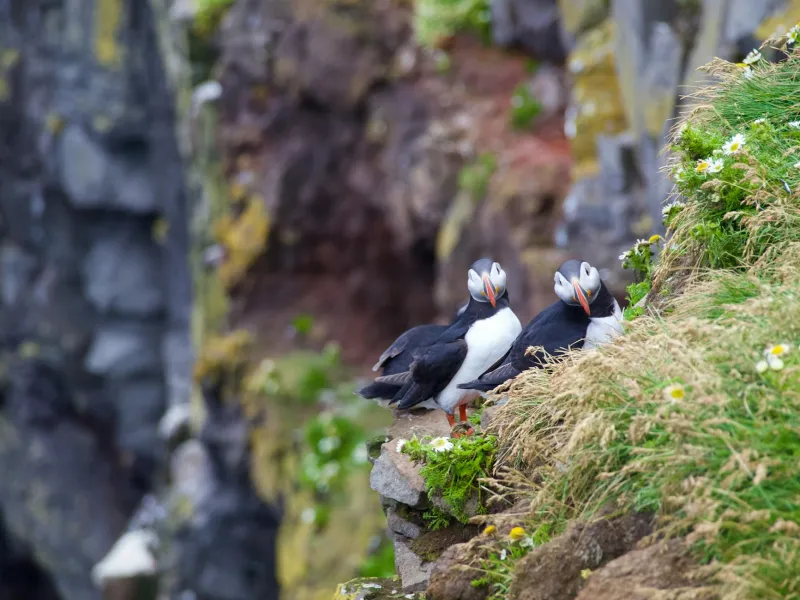
The most absurd twist in this already absurd story involves Atlantic puffins. Machias Seal Island is home to one of the largest puffin colonies in the Gulf of Maine, and both countries have made the birds' welfare a cornerstone of their territorial claims.
Canada argues that its long stewardship of the island, including environmental protection efforts, demonstrates effective sovereignty. The United States counters that American conservation laws and research programs prove the island falls under U.S. jurisdiction. Both countries issue permits for researchers and bird-watchers to visit the island, creating the bizarre spectacle of tourists needing documentation from two different governments to watch the same puffins.
The birds, presumably, remain neutral in the dispute.
The War That Will Never Come
What makes the Machias Seal Island dispute truly remarkable is how utterly civilized it remains. Both countries maintain their claims, but neither shows any interest in forcing the issue. Canadian Coast Guard personnel continue to maintain the lighthouse and conduct sovereignty patrols. American researchers continue to study the local ecosystem under U.S. permits. Fishermen from both countries work the surrounding waters without incident.
It's as if both governments have quietly decided that having an unresolved territorial dispute is more interesting than actually resolving it. The island has become a kind of diplomatic curiosity—proof that two modern nations can disagree about sovereignty while still managing to coexist peacefully in the same small space.
The Question Nobody Wants to Answer
The strangest aspect of the Machias Seal Island dispute isn't that it exists, but that both countries seem content to let it continue indefinitely. Legal scholars have proposed dozens of ways to resolve the matter, from international arbitration to joint administration to simply flipping a coin. Both governments politely acknowledge these suggestions and then do absolutely nothing about them.
Perhaps the real truth is that Machias Seal Island serves a purpose precisely because it's disputed. In an age of GPS coordinates and satellite mapping, it's oddly comforting to know that somewhere in North America, there's still a small mystery that hasn't been solved by bureaucrats with clipboards.
The Rock That Time Forgot
Machias Seal Island stands as a monument to the limits of human organization. Two of the world's most methodical governments have spent two and a half centuries trying to figure out who owns a piece of rock that's smaller than most city blocks, and they're no closer to an answer than they were in 1783.
In the end, maybe that's the point. The island belongs to neither country and both countries, existing in a state of permanent diplomatic suspension that's more poetic than any treaty could ever be. It's a reminder that sometimes the most interesting borders are the ones that nobody can quite figure out how to draw.
And the puffins? They just keep coming back every summer, blissfully unaware that they're living at the center of North America's most polite international incident.