The Accidental Noise That Ruined Every Morning in America
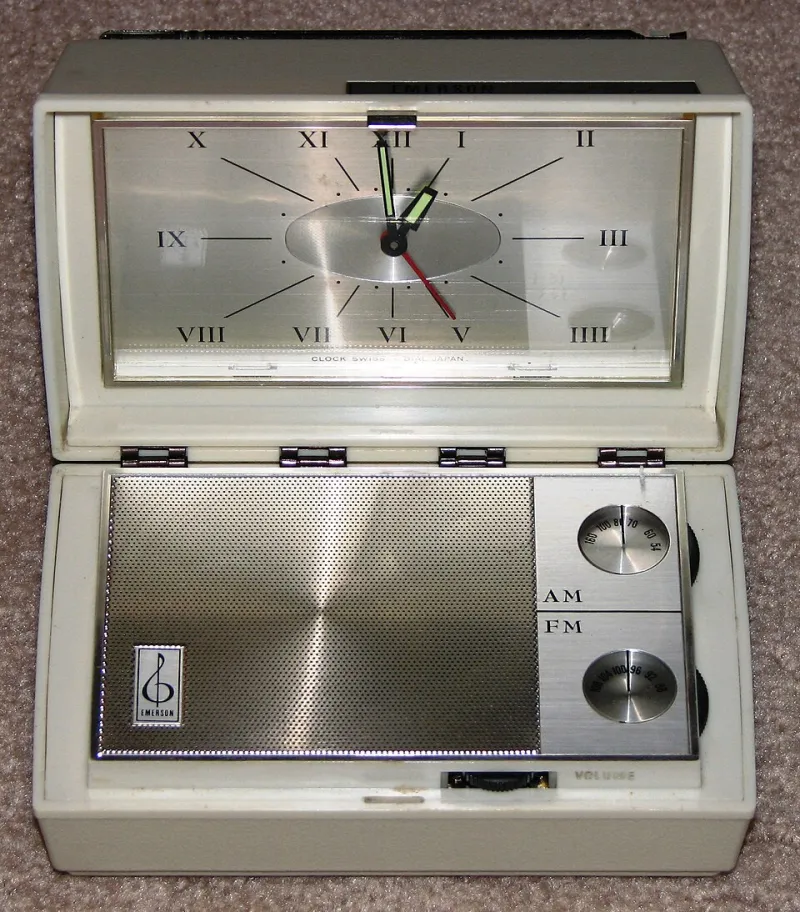
Photo: Joe Haupt from USA, CC BY-SA 2.0, via Wikimedia Commons
Somewhere in America right now, an alarm is going off. Maybe it's yours. And if it is, you already know the feeling — that sharp, serrated jolt of sound that rips you out of sleep like a hook through a fish. It's awful. It's deeply, personally awful. And here's the part that should make you feel even worse about it: nobody designed that sound to be that way. It happened by accident, in a cluttered industrial workspace, because someone dropped something.
A Tool, a Cabinet, and a Very Curious Engineer
In 1962, a product engineer working with adhesive materials at a manufacturing facility was doing what engineers do — tinkering, testing, and occasionally being clumsy. When a metal tool slipped from his hand and struck the side of a resonant metal filing cabinet, something unusual happened. Instead of ignoring the clang the way any reasonable person would, he stopped and listened. The sound had a particular quality to it — a sharp initial strike followed by a ringing harmonic decay that seemed to cut through ambient noise in a way that felt almost aggressive.
Curiosity, as it so often does, did the rest. He grabbed a recording device and captured the acoustic event, partly as a note to himself and partly because that's what curious people do when something sounds strange. He wasn't researching alarm systems. He wasn't studying human psychology. He was just a man who thought a dropped tool made an interesting noise.
That recording didn't immediately change the world. It sat around, got referenced, got borrowed, and eventually filtered into industrial sound design in ways that are genuinely difficult to trace with precision. But the core frequency combination it captured — that sharp attack paired with a sustaining harmonic ring — became a foundational blueprint for what we now recognize as the modern alarm clock tone.
Why That Sound Is So Specifically Terrible
Here's where the story gets genuinely eerie. Decades after that accidental recording, neuroscientists and acoustic researchers started studying alarm sounds with serious rigor, trying to understand why certain tones are so much more effective at waking people up than others. What they found was unsettling in the best possible way.
The frequency range captured in that original accidental recording — roughly in the 2,000 to 5,000 Hz band with a sharp transient attack — happens to align almost perfectly with the range that the human auditory system is most sensitive to. This isn't a coincidence of engineering. It's a coincidence of anatomy. The human ear evolved to be hyperresponsive to sounds in this range because, for most of human history, sounds in this range meant something was very wrong. A snapping branch. A predator's cry. A child's scream.
When your alarm goes off, your brain isn't just waking up. It's triggering a mild threat response. Your cortisol spikes. Your heart rate jumps. Your body goes from rest to alert in a fraction of a second — not because you're in danger, but because your ancient nervous system has been fooled by a frequency range that evolution hardwired you to take seriously.
Researchers who have studied the phenomenon describe the ideal alarm sound as one that is "spectrally rich, temporally irregular, and pitched within the range of maximum cochlear sensitivity." Which is a very scientific way of saying: it sounds bad on purpose. Except, in this case, it didn't sound bad on purpose at all. It just happened to be exactly what a dropped metal tool sounds like when it hits a resonant surface.
The Sound That Nobody Owned
What makes this story stranger is the question of authorship. No one sat down and said, "I am going to design a sound that neurologically distresses human beings into wakefulness." There was no patent filed on the frequency combination. There was no design brief, no focus group, no product launch. The sound that billions of people around the world now wake up to every morning — the sound that most people, if asked, would identify as one of the most unpleasant parts of their day — entered the world the same way most accidents do: without warning and without anyone really understanding what had just happened.
Modern alarm tones have been refined and iterated on since then, of course. Smartphone manufacturers have added their own variations. Sleep researchers have proposed gentler alternatives — gradual tones, nature sounds, light-based alarms. Some of these work reasonably well. But the default? The classic buzzing, ringing, insistent alarm that most Americans still use? Its DNA traces back to that filing cabinet moment, and to the neurological quirk that made it accidentally perfect for its eventual purpose.
The Uncomfortable Punchline
There's something almost poetic about the fact that the most universally hated sound in modern life was never engineered to be hated. It wasn't the result of indifference or cruelty. It was the result of a man being curious about a noise, a recording that outlived its context, and a series of small decisions made by people who had no idea they were building the soundtrack to humanity's least favorite moment of every day.
The next time your alarm goes off — and it will — take one brief, groggy second to appreciate the full absurdity of it. You're being jolted awake by an accidental recording of a dropped tool, filtered through decades of industrial sound design, triggering a threat response that evolution built to keep you alive in the wilderness. All because someone, sixty-some years ago, thought a funny noise was worth writing down.
Reality is strange. It just usually waits until you're half-asleep to prove it.