Nobody Could Stop Dancing: The 1518 Epidemic That Killed People With Movement
Photo: Scotch Mist, CC BY-SA 4.0, via Wikimedia Commons
Imagine watching your neighbor step outside one morning and begin to dance. Not joyfully, not at a festival — just compulsively, relentlessly, in the middle of the street. Now imagine that by the following week, dozens of people are doing the same thing. And that city officials, baffled and frightened, respond by hiring professional musicians to accompany the dancers, reasoning that the best cure for uncontrollable dancing might be to simply let it run its course.
This actually happened. In Strasbourg, in the summer of 1518, in a documented, historically verified episode that remains one of the most genuinely inexplicable events in recorded European history.
It Started With One Woman
In July of 1518, a woman named Frau Troffea walked out of her home in Strasbourg — then part of the Holy Roman Empire — and began to dance. She didn't stop. For days she kept moving, apparently unable or unwilling to rest. Within a week, somewhere between 30 and 34 people had joined her. Within a month, the number had swelled to around 400.
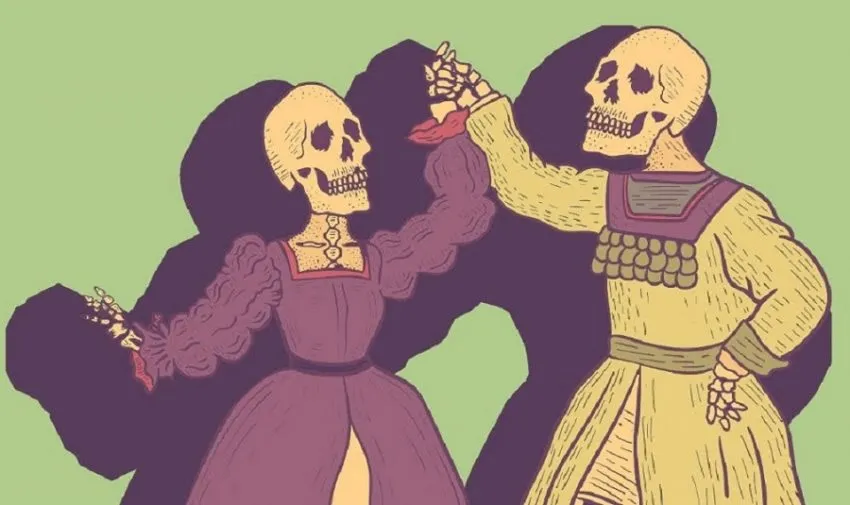 Photo: Frau Troffea, via khronoshistoria.com
This wasn't joyful, celebratory movement. Contemporary accounts, including physician records and city council notes — documents that still exist and have been examined by modern historians — describe people dancing with expressions of anguish. Some collapsed from exhaustion and were revived, only to start dancing again. Others reportedly danced until their feet bled, until their joints gave out, until their hearts failed. Chroniclers from the period put the death toll at several dozen, though the exact number is difficult to confirm.
The city of Strasbourg was not dealing with a festival that had gotten out of hand. It was dealing with something nobody had a name for.
The Official Response Was Remarkably Strange
Here's the part that really makes you appreciate how differently medieval authorities thought about the world: rather than isolating the dancers or restricting movement, Strasbourg's city council decided the affliction needed to be danced out.
They cleared two guild halls and an open-air grain market to give the dancers space. They hired professional musicians — drummers, pipers, players — to provide accompaniment, operating under the theory that structured music might regulate the chaotic movement and eventually bring it to a natural end. They also reportedly brought in some additional healthy people to dance alongside the afflicted, hoping the energy might dissipate faster in a crowd.
The dancing spread instead.
Eventually, the council reversed course. They banned music, shut down the guildhalls, expelled the professional musicians, and sent the dancers to a mountaintop shrine dedicated to Saint Vitus — the patron saint of, among other things, epilepsy and compulsive movement. Whether that helped or whether the epidemic simply burned itself out is unclear. By September 1518, the dancing had stopped. And nobody then, or since, has produced a fully satisfying explanation for why it started.
 Photo: Saint Vitus, via townsquare.media
The Theories, None of Them Quite Right
Modern researchers have approached the Strasbourg dancing plague from several angles, and each theory illuminates something while leaving other questions unanswered.
Ergot poisoning is one of the most commonly cited explanations. Ergot is a fungus that grows on rye grain and contains compounds chemically related to LSD. Consuming ergot-contaminated bread can cause convulsions, hallucinations, and involuntary muscle movements. It's been linked to other episodes of mass strange behavior in European history. The problem is that ergot poisoning tends to produce rigid, contracted muscles — not sustained, coordinated dancing over days and weeks.
Mass psychogenic illness — what used to be called mass hysteria — is the explanation favored by historian John Waller, who has written extensively about the 1518 episode. His argument is that Strasbourg in 1518 was under severe stress: famine, plague, economic hardship, and religious anxiety created a population primed for psychological contagion. In a culture that genuinely believed in Saint Vitus's ability to curse people with compulsive dancing, the power of suggestion and shared belief could have produced real, physical symptoms that spread socially rather than biologically.
This is a compelling argument. It also doesn't explain how people danced for days without sleeping, or why the movement continued even when individuals appeared to be in genuine physical distress and not simply performing.
Shared trance states brought on by religious fervor have also been proposed. Medieval European communities occasionally engaged in ecstatic religious practices that could produce altered states. Some researchers suggest the dancing may have begun as a form of spiritual expression that spiraled beyond anyone's control.
None of these explanations, individually, accounts for all the documented details.
Why This Story Matters Beyond the Weirdness
The 1518 dancing plague shows up in medical history, psychology textbooks, and cultural studies for a reason that goes beyond its obvious strangeness. It's a window into how communities respond to the unexplainable.
Strasbourg's city council was not composed of fools. They were administrators trying to manage a genuine public health crisis with the tools and conceptual frameworks available to them. Their decision to hire musicians wasn't irrational — it was a reasonable attempt to apply the dominant medical theory of the day, which held that certain conditions needed to be expressed and exhausted rather than suppressed.
The episode also raises uncomfortable questions about the relationship between belief, social environment, and physical experience. If mass psychogenic illness can genuinely cause people to dance until their hearts give out, that tells us something profound and unsettling about how much of human physiology operates through the mind.
Five hundred years later, Frau Troffea's name is still attached to one of history's most baffling outbreaks. We still don't know exactly what she experienced when she walked out of her door that July morning.
We just know she couldn't stop moving. And that before long, neither could hundreds of people around her.
Some epidemics spread through the air. This one, apparently, spread through something even harder to contain.